by Nandini Nayar, illustrated by Proiti Roy. (Tricycle Press, 2009. First published in 2006 by Tulika Publishers, Chennai, India in English and Hindi.)
A little boy, Neeraj, helps his mother make chapatis, an Indian flat bread in this appealing children’s books from India.
Song: One From the Left by Jim Gill
This is a great song for stretching those fingers (plus counting!)
Book: Dave the Potter
by Laban Carrick Hill, illustrated by Bryan Collier. (Little, Brown, 2010). Caldecott Honor & Coretta Scott King Award Winner, 2011.
Explore STEAM, art, and poetry extension activities for teachers (Dave-Edu-Extension) and parents and families (Dave-Parents created by Reading is Fundamental (RIF).
Activity: Create with play dough
Play dough is great for building hand strength — pushing, pulling, kneading, shaping with dough uses lots of hand and finger muscles. It’s also pretty easy to make at home, and generally is much more pliable than store bought play dough. There are many recipes out there, and you can add color and scent (with kool-aid mix!) if you choose.
Easy basic play dough recipe
1 cup flour
1/2 cup salt
1 cup water
1 tablespoon vegetable oil
food coloring
Boil water and add the food coloring, then mix with other ingredients. Mix/knead until a soft dough forms. No cooking needed! Many recipes use cream of tartar, which helps the play dough last longer, but it works fine without it (I tested it to make sure!) This is very forgiving — if it is sticky, just add more flour. If it is too dry, add water (just a little at at time). Keep in a plastic bag and it will last for a few weeks!
More Books!
Find additional books & e-books about clay, dough (think pizza dough & cookie dough) and tactile/sensory projects to explore with kids.
Take a walk around your backyard, your neighborhood, or a nearby park to hunt for seeds. Examples include: acorn or walnut shells, pinecones (try shaking the seeds out), dandelion flowers, etc. Have you ever looked at a dandelion puff really closely? They are pretty amazing:
Virtual Wonderworks was presented May 5, 2020 live on Westerville Public Library’s Facebook page.
Falling for Rapunzel by Leah Wilcox (Penguin, 2003)
I love fairy tales and using them to explore science (like with bridges & The Three Billy Goats Gruff, which we explored earlier this spring). Leah Wilcox’s fractured take on Rapunzel is so much fun to share with kids!
This is a fun one that builds listening awareness as children move high as the musical line rises higher, and then move their bodies back down as the sound pitch lowers. This fantastic video is from Jim Gill’s website and features kids of all ages:
(After all, you can’t build a skyscraper without an elevator!)
Book: Anastasia Suen’s Up Up Skyscraper (Charlesbridge, 2017)
is a wonderful nonfiction introduction to building for preschoolers. It has details to satisfy those curious young minds presented in simple words and illustrations so that you actually gain an understanding the building process.
For more books and e-books on skyscrapers and other tall towers, including the Eiffel Tower, search the library catalog.
Activity: Building with Everyday Materials
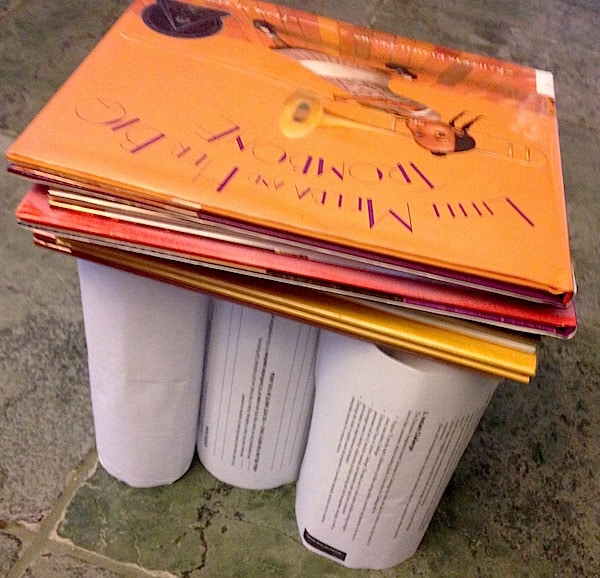
Use whatever you have at home to build towers: blocks, legos, or create your own set of blocks from recycled materials. Save those cereal boxes, oatmeal containers, cracker boxes, almost any kind of box will do! You’ll need to tape any open ends so that kids can build with them. Other great “blocks” include butter and egg cartons, toilet paper rolls, and paper towel tubes.These materials are light enough that they won’t injure anyone when they topple over, and you can build pretty high and still get a satisfying sound when they do come crashing down.
I try not to have many rules for children in programs and to keep things as open-ended as possible, but I do share one rule for in-person building programs that may serve families with siblings well. First I ask if they like knocking down towers (and most respond with vigorous head nodding), and then I ask how it feels when someone else knocks down their tower (often there is no response but a lot more serious/sad faces.) Then I explain the rule: If you build it, you can knock it down.
The first three challenges involves building towers, two with paper.
Activity: Cup Stacking
Another activity you can try at home is cup stacking. This is an activity that is fun for kids from toddlers to age 12 (though you’ll see widely differing results, it is fun for all ages). See examples from Bedtime Math’s “Crazy for Cup Stacking.”
In this collage, Matisse used squares of colored paper to create a snail.Can you find a spiral in this image? The original artwork is in the collected of the MOMA (Museum of Modern Art) in New York City. Learn more about Matisse and his collages in the online exhibition: https://www.moma.org/interactives/exhibitions/2014/matisse/the-cut-outs.html.You’ll find photos of Matisse in his studio and cutting and arranging the works.
Activity: What can you make with a square?
Try making a collage. You can tear paper (fun!) or use scissors (which is a great fine motor skill to work on.) Try to stick with using squares for one collage — then make whatever shapes you like.
Here are some examples from Perfect Square. You can look at these perfect square activities, print them out if you like, or use your own ideas to create YOUR collage.
These photos are from a similar program a few years ago in the library. I love how different and distinctive the creations are. This is a great opportunity for children to create in their own way, as there is no right or wrong way, and kids can be free to explore. Also, you can use scrap paper, bits of whatever you have around, color them if you want — remember, Matisse started with a brown paper bag!
With the 50th annual celebration Earth Day this week, we’ll explore some of the wonders of nature all around us, and spring is a great time to do that — right in your own backyard or neighborhood.
The books I’m sharing today focus on prediction, utilizing interactive elements like holes to or peek through or flaps to lift and reveal. This is both fun and builds children’s skills at guessing and prediction, which are skills that all scientists need.
What Will I Be? by Nicola Davies, illustrated by Marc Boutavant
*available on Cloud Library as an audiobook production by Weston Woods.
Seeger uses die cuts as an integral part of this story to answer (or not?!) the age old questions of which came first? Her website offers many ideas for creative exploration based on her books, which also include Green, Blue, Lemons are Not Red, and many others: https://studiolvs.com/educators-kids.
Share these images with your child and print them out if you have a printer. Then cut the cards and ask your child to put them in the correct sequence. Talk about the life cycle of the frog, butterfly and chicken.
Other nature “Adventure Activities”:
Spring is a great time to observe parts of animal and plant life cycles — as the birds busily build their nests and green returns to the trees. Here are a few more activities to facilitate our appreciation of trees for this Earth Day (April 22) and Arbor Day (April 24). These are from Nature Explore, which offers a family engagement kit with many more activities (you’ll need to register to download the whole thing) and I’ve included a few tree activities here:
Fine more ways to celebrate Earth Day with the Exploratorium, a fantastic hands-on science museum from San Francisco, which is having a virtual celebration on April 22 and offers ideas for additional activities you can complete any time.
——————————————————————-
“All that I hope to say in books, all that I ever hope to say, is that I love the world.” – E. B. White
Birdwatching is a great family activity that you can do at home and in your neighborhood. When my kids were younger, we started participating in Project Feederwatch, a citizen scientist program in which you count birds in your yard over a series of months (November to April), sponsored by the Cornell Lab of Ornithology. Their common feeder birds poster is still on our wall in the kitchen, and helps remind us of the names of the birds every year. You can download one here: https://feederwatch.org/wp-content/uploads/2014/09/PFW_Mini_Poster.pdf
Bird calls are another way to identify birds, and one I’m continually working on. So for today’s storytime, I decided to focus on bird calls.
Froodleby Antoinette Portis is a funny book about a little brown bird who wants to chirp their own way, with a great message about individuality, as well as sharing some familiar bird calls. It is available in the Westerville Library Cloud Library.
Birdsongs by Betsy Franco, with beautiful collage illustrations by Steve Jenkins, shares different birdsongs in a playful manner.
Take a few minutes to listen to the Northern Cardinal song here (Ohio’s state bird) and learn a bit about bird anatomy too!
More books:
Julie Flett’s Birdsongis available on Hoopla (*and in the Cloud Library.)
I hope you will consider going out to birdwatch in your own backyard — or even just looking out your window! A great tool for birdwatching is the Merlin Bird Identification app (free, iOS & Android), also from Cornell Lab, which helps identify birds.
It is very child-friendly, requiring very little reading, and helps young scientists work on observation skills. The app asks for the size of bird, then gives a range for them to choose from. It ask for up to 3 colors seen, and where the bird was seen (on the ground, at a feeder, in flight). After a few questions, the app returns a list of possible birds sighted. This app is built on the 4 characters all birdwatchers use to identify birds:
Size & shape
Color Pattern
Behavior
Habitat
You can also upload a photo to Merlin and it will suggest an identification. You can practice using the Merlin app inside, with a photo of a bird, even if you don’t see one at the moment. Photos below are from practice a few years ago during an in-person storytime at the library.
Paper Birds
Our craft is a simple paper bird craft, inspired by a Swedish bird craft. Every spring, Swedes bring branches indoors to force blooms early and also decorate these branches with bright feathers and often with little paper birds. We have made this in celebration of our sister library in Gislaved Sweden in previous years in the library:
You can make a paper bird at home and design the bird to look like a bird you might see in your own backyard. I’ve created a robin, cardinal, and eastern bluebird for examples:
Here is a basic bird pattern you can use; you can also draw the outline freehand, and make it bigger or smaller, depending on the bird you choose to create. Cut one pattern, then trace it on different sheets of paper to make multiple birds.
Fold the bird’s body partway and cut a small slit — this is where you will put the wings through.
Use colored paper, markers, or whatever you have on hand to add details to your bird.
Next, cut an approximately 6×6 square of paper, either the same color as your bird, or perhaps different if it has different colored wings. Thinner paper, like tissue paper, works well for the wings, but any paper will work. Accordion fold the paper, then insert into into the slot. Fan out the paper wings.
Punch a hole about the wings and tie a string or piece of yarn through to hang your bird.
This is a very forgiving pattern, so you can make adjustments as needed and still get good results. Also, take a look at the bird poster or a photo on the Merlin app and design a bird with attributes of the real bird. This will help children remember the actual birds when they see them outside!
A visitor outside my window last week:
Music
Enjoy “Little Bird” by Elizabeth Mitchell on this YouTube video from Smithsonian Folkways recordings while you craft.
Our first book is The Three Billy Goats Gruff, illustrated by Janet Stevens. Check out the eldest of the Gruff brothers, one of the hippest, toughest brothers I’ve seen in a picture book:
You can create the “trip-trap” sound of the goats hooves on the bridge, patting your hands on your knees and getting louder as the brothers grow in size, even hitting the floor to make the loudest “trip-trap” sounds with the biggest brother. This is a fun story to act out after reading the book, and you’ll be building children’s memories as they recall the sequence of events.
You can learn about different types of bridges and their names in this powerpoint video:
One of my favorite bridges is London’s Tower Bridge, which features a drawbridge (bascule) that goes up to allow boats to pass underneath. We watched a simple animation of a drawbridge:
You can build your own drawbridge out of a cereal box. It is a fairly simple project, but cutting cardboard, punching holes, and measuring the yarn requires adult assistance.
Directions: Remove the top flaps of the box. Punch 4 holes (one at each corner). Cut two long sides of the box so that one side opens (see photo below.) Thread yarn through each hole and tie. Make it long enough that the open edge can extend flat — so that it is a bridge! Pull on the yarn from the upright side to lift the bridge. Decorate the inside however you like — a road, a path to a castle, a train track. Add matchbox cars or lego people for pretend play!
An additional activity is retelling the story of the Three Billy Goats Gruff using sequencing cards pictured below. You can download a .pdf here: 3goats story cards
Encourage your child to put the cards in order and tell the story to you. You can give them hints or reminders if they ask. You can also encourage them to explain why they put the cards in a certain order — it’s okay for them to be creative and make up their own version, or change what happened.
This past weekend was great for getting outside! While cleaning up some flowerbeds and digging up some weeds, I discovered a fair number of wiggly worms. And that was the inspiration for today’s storytime. If you have a bit of a yard or green space, consider designating a small space for your child to dig. You might just discover some worms in your backyard!
Today we read:
I Can Only Draw Wormsby Will Mabbitt
and
Worms by Laura K. Murray
For today’s wiggly paper worm craft, you need:
paper (strip of paper, 1 inch wide x 5 1/2 inches long — approximately)
Clouds are amazing. A few years ago I took photographs of the sky at different times when I saw different clouds. Soon I had enough photographs to illustrate several different types of clouds that we are learning about: cirrus,cumulus,stratus, and nimbus. This topic is great for vocabulary; what a funny word cumulonimbus is! Try saying it slow . . . then fast! Hard c sounds and soft c sounds . . . c really is for cloud! This topic exercises your observation skills, which are critical for scientists.
Rhyme: Rain is Falling Down
Adapted from: Jane Cobb’s I’m a Little Teapot
Rain is falling down Flutter fingers downward
Splash! Tap floor with hand
Rain is falling down
Splash!
Pitter patter, pitter patter
Rain is falling down
Splash! (repeat: falling lightly – just touch with fingers; falling hard –slap floor with whole hand)
Charles Shaw’s classic, It Looked Like Spilt Milk. Look out your window or go outside and look up at the sky. If weather permits, take a blanket and lie down, look up and talk about what shapes you see in the clouds.
Dragon is Coming by Valeri Gorbachev. After reading, ask your young listener what each of the dragon’s attributes actually is (for example — the dragon’s roar is thunder, his fiery breath is lightning . . .)
and The Cloud Bookby Tomie dePaola, which is also available as an e-book through Ohio Digital Library.
Hands on activities
Cotton Ball Clouds
Materials needed:
cotton balls
blue paper (use a crayon to color your sky blue if you only have white paper)
glue or glue stick
glitter (optional)
Remember the names of the clouds we read about today? Create different kinds of clouds with cotton balls —
stretch them into long thin strips for cirrus clouds, fluff them up to make cumulus clouds, and add glitter (optional!) to represent water droplets getting so heavy that they are about to rain from the cumulonimbus clouds.
Cloud Viewer
Materials needed:
Cardboard (back of a cereal box is a good size)
Scissors
cloudidentifierphotos (This links to a .pdf you can print of the photos below. If you don’t have a printer, trying drawing them. They don’t have to be perfect, and the exercise of drawing them will reinforce the learning).
Websites & Apps to explore
For more information on the types of clouds, try this site from the
The Juno spacecraft continues to send back amazing photographs of Jupiter on its’ regular flybys. Pictured above is one of the stunning images of Jupiter’s southern hemisphere. Take a look at more of the spectacular images here. (Warning! It’s easy to get lost in time browsing these.)
Does anyone remember the initial excitement around Juno? The Juno spacecraft arrived near Jupiter on July 4, 2016. This was a big deal (in pre-solar eclipse times).
As the library was closed on July 4th, we celebrated on July 5 with a “Jump to Jupiter” program based on Star_Net libraries‘ program of the same name, Jump to Jupiter, available at their STEM Activity Clearinghouse. I saw this program demonstrated at ALA Midwinter, during a Deep Dive session offered by Star_Net Libraries: Creating Out-Of-This World Children’s Science Programming with Free NASA Resources, and was excited to try it in the library.
The big idea for this program was that “Space is big.” Of course it is — you know that! – but creating a scale model of the solar system really helps to convey this idea in concrete, physical terms. It definitely helped me to more fully appreciate the distances between and sizes of planets.
The model is to scale — both in terms of the planets relative size and their relationship to one another. To begin with, the sun is a grapefruit. This means Mercury is a barely visible speck, and the earth is a sea salt crystal. The inner planets were attached to a card so that a volunteer could hold them.
After an introduction in the meeting rooms, children began their planetary journey at the sun, just outside the door. The inner planets were able to be placed in the main hallway, within the sightline of the sun. That way you could explain to the children that they could see how big the sun would look if they were actually standing on the surface of that planet.
After Mars, the course got a bit more irregular, heading up the staircase to the adult section to find Jupiter (a wooden pony bead), then winding back down the stairs, across the atrium, past the media and teen sections and all the way to the back of the youth department and then reversing course to reach Saturn.
From there, the journey reversed back through the hallway to Uranus. Neptune and Pluto were outside the library — down the sidewalk and then several blocks toward Uptown Westerville. A sign (and a volunteer during the busiest time) asked children not to leave the library without a grownup!
Teen volunteers manned each planetary station, equipped with fun facts about their planet and a sticker for each participant’s bookmark.
Completed bookmarks were turned in and children could choose a Juno Mission Patch button at the end of their journey.
Read about how another library adapted this program for their library:




 The Juno spacecraft continues to send back amazing photographs of Jupiter on its’ regular flybys. Pictured above is one of the stunning images of Jupiter’s southern hemisphere. Take a look at more of the spectacular images
 The model is to scale — both in terms of the planets relative size and their relationship to one another. To begin with, the sun is a grapefruit. This means Mercury is a barely visible speck, and the earth is a sea salt crystal. The inner planets were attached to a card so that a volunteer could hold them.


